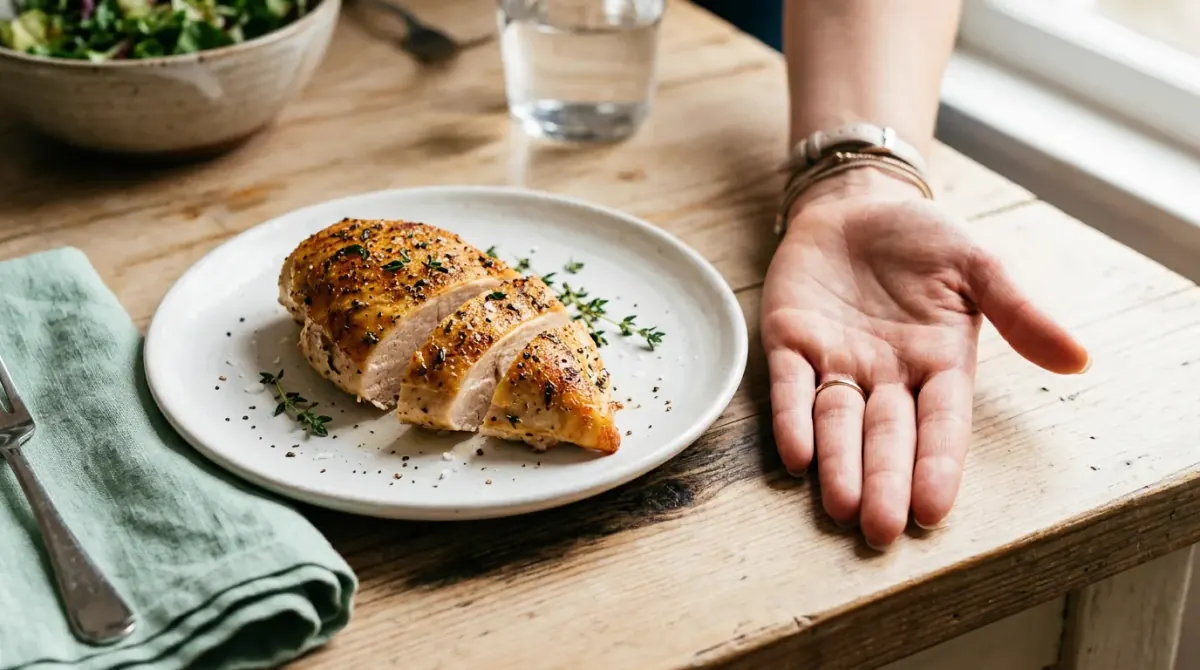
You can count calories without a food scale, and most people who keep tracking for more than a few weeks do. The method is simple: use your hand for the food, use the package for anything with a label, and pay attention to fat, because that is where eyeballed logs go wrong. The numbers below are approximate, and for weight management approximate is enough as long as you are consistent.
The hand method, with numbers
Your hand is always with you and it scales roughly with your body, which is why dietitians have taught hand portions for decades. These are the four references worth memorising.
| Hand reference | Roughly equals | Typical calories |
|---|---|---|
| Closed fist | 1 cup of cooked rice, pasta or cereal | About 200 kcal for cooked rice or pasta |
| Palm, no fingers | 100 to 120 g of cooked meat, fish or paneer | About 165 to 200 kcal for chicken breast |
| Cupped hand | Half a cup, or about 30 g of nuts | About 100 kcal for rice, 170 kcal for almonds |
| Whole thumb | 1 tablespoon of oil, butter or nut butter | About 120 kcal for oil, 95 kcal for peanut butter |
| Thumb tip | 1 teaspoon of oil, ghee or sugar | About 40 kcal for oil, 16 to 20 kcal for sugar |
Hands differ, so treat these as a starting point and calibrate once. The next time you are near a measuring cup, fill it with rice and tip it onto a plate next to your fist. After that you know whether your fist runs large or small, and you never need to measure again.
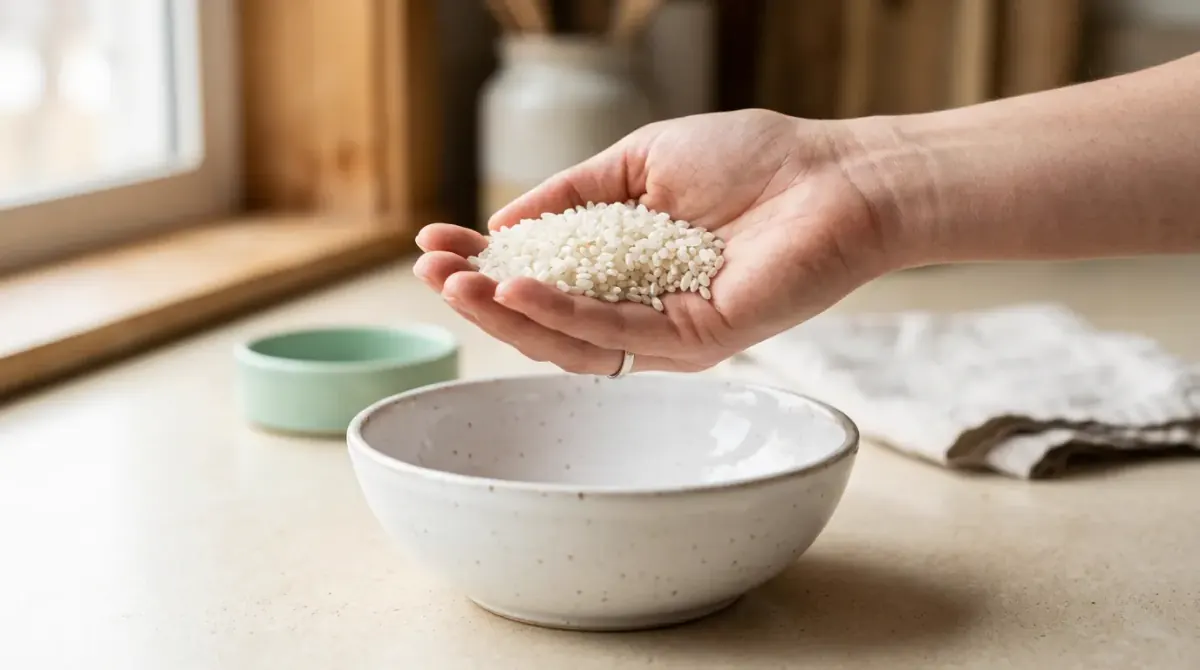
How much is a handful or a bowl of cereal?
This is the question people ask most, because cereal is the food we pour without looking. A cupped handful of flake cereal is roughly 15 to 25 g. Most cereal boxes list a serving of 30 to 40 g, so one serving is about two handfuls.
A bowl poured freely is usually more than one serving, often one and a half to two. The quickest fix is to weigh or measure one normal bowl once, note what it comes to, and log that number every time. If your usual bowl is 60 g and the box says 30 g, you eat two servings, plus the milk.
Use the package before you guess grams
If the food came out of a package, the package has already done the weighing. A 400 g tub with 120 kcal per 100 g holds 480 kcal. A quarter of the tub is 120 kcal and half is 240 kcal. You only have to judge the fraction, which is far easier than judging grams.
Check which number the label is giving you: per serving, per 100 g, or per pack. The FDA label guide explains the difference. Counting pieces works the same way. If a pack of 12 biscuits is 600 kcal, three biscuits are 150 kcal.
Raw or cooked: pick one and stay with it
Rice and pasta roughly triple in weight when cooked because they absorb water. Meat loses about a quarter of its weight because it gives water up. So 100 g of dry rice is about 360 kcal, and 100 g of cooked rice is about 130 kcal. Mixing the two is the most common large mistake in a food log.
If you are describing what is on your plate, you are describing cooked food, so say so: “one fist of cooked rice”. USDA FoodData Central lists both states if you want to check a specific food.
The calories you cannot see
Eyeballing vegetables badly costs you almost nothing. Eyeballing fat badly costs you a meal. These are the items worth being careful about.
| Food | Amount | Calories |
|---|---|---|
| Cooking oil | 1 tablespoon | About 120 kcal |
| Butter | 1 tablespoon | About 100 kcal |
| Ghee | 1 teaspoon | About 45 kcal |
| Peanut butter | 1 tablespoon | About 95 kcal |
| Almonds | 1 cupped handful (30 g) | About 170 kcal |
| Cheddar cheese | A piece the size of two thumbs (30 g) | About 120 kcal |
| Mayonnaise | 1 tablespoon | About 90 to 100 kcal |
If you measure nothing else, measure the oil. One free pour into a pan is often two tablespoons.
For a dish you share, count your share of the oil, not the whole pan. If two tablespoons went into a curry for four people, your plate has about half a tablespoon, or 60 kcal.
Leftovers and second helpings
Log what went into your mouth. If you served two fists of rice and left half a fist, you ate one and a half. If you went back for more, add it. Restaurant plates need this most, because the portion is set by the kitchen and is often larger than what you would serve at home.
What a no-scale log looks like
Here is a dinner described the way you would say it out loud, with the estimate each part produces.
| What you say | What it means | Estimate |
|---|---|---|
| One fist of cooked rice | About 1 cup | About 200 kcal |
| A palm of grilled chicken | About 110 g cooked | About 180 kcal |
| A fist of stir-fried vegetables | About 1 cup | About 60 kcal |
| Cooked in a thumb of oil, shared by two | Half a tablespoon each | About 60 kcal |
| Total | About 500 kcal |
That took four short phrases. In an AI calorie counter such as Calur you can type or say exactly those phrases, or take a photo and add the oil in words, and the entry is built for you. If you realise later that you left some rice, say so and the meal is corrected rather than logged twice.
When a scale is still worth using
A scale earns its place in three situations: when you calibrate a bowl or your hand once, when you eat a calorie-dense food every day (nuts, granola, oil), and when your weight has not moved for three or four weeks and you want to find out why. In the last case, weigh everything for one week. It usually shows that one or two foods were larger than you thought.
Counting only helps if you know what you are counting towards. The TDEE calculator estimates your maintenance calories and the calorie deficit calculator turns that into a daily target.
If you cook Indian food at home, the same ideas apply to rotis, katoris and tadka. See the Indian food calorie guide for those numbers.
Frequently asked questions
- Can you count calories accurately without a food scale?
- Accurately enough for weight management, yes. Hand portions and package fractions get most foods close, and the errors tend to stay consistent from day to day. Fats such as oil, butter and nuts are the exception and are worth measuring.
- How many calories are in a handful?
- It depends on the food. A cupped handful is about half a cup: roughly 100 kcal of cooked rice, 15 to 25 g of flake cereal (about 60 to 90 kcal), or 30 g of almonds (about 170 kcal).
- How big is one serving of cereal without measuring?
- Most boxes list 30 to 40 g, which is about two cupped handfuls of flake cereal. A bowl poured freely is often one and a half to two servings, so measure your usual bowl once and reuse that number.
- Should I count food raw or cooked?
- Either, as long as the number you use matches the state of the food. Cooked rice is about 130 kcal per 100 g and dry rice about 360 kcal per 100 g. If you are describing your plate, you are describing cooked food.
- How do I count calories when eating out?
- Use published nutrition information if the restaurant has it. Otherwise describe the plate in hand portions, assume more oil or butter than you would use at home, and log only the amount you ate.
Published by the makers of Calur. About these guides and how they are prepared.