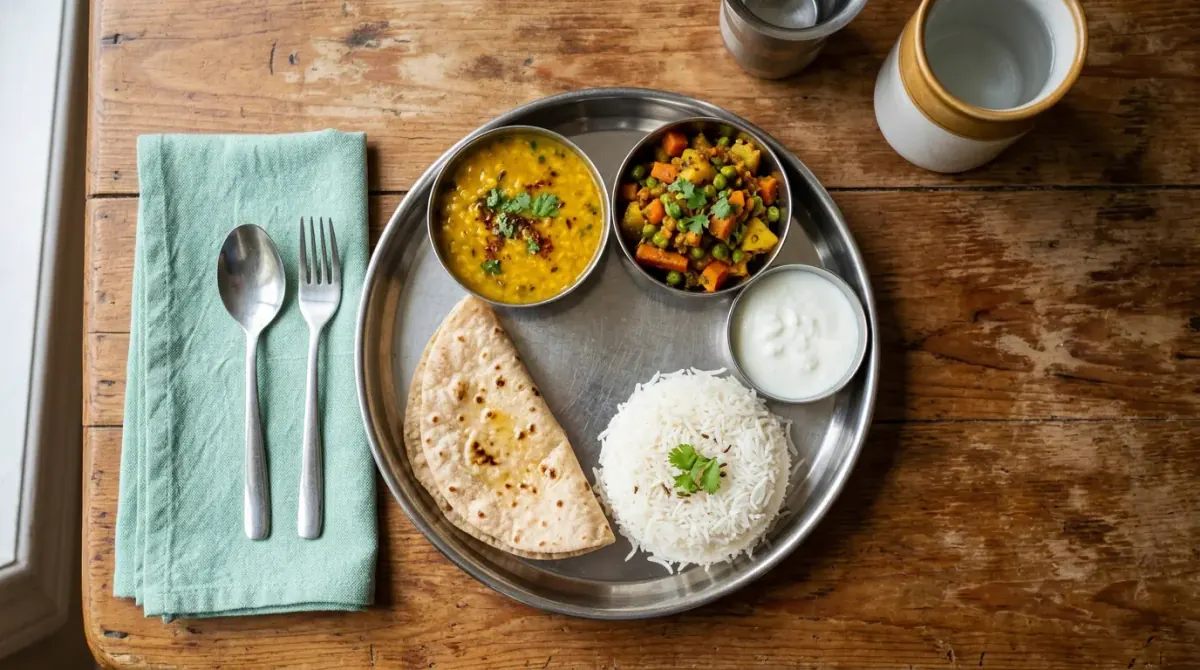
Most calorie counters were built around packaged food with a barcode. Indian home food has no barcode. It has a roti that changes size from one kitchen to the next, a katori of dal whose calories depend on the tadka, and a cup of chai nobody thinks to log. This guide gives you working numbers for the foods you eat most often and a way to log a full thali in under a minute.
Calories in common Indian foods
These are typical home portions. Restaurant versions are usually higher because of extra oil, butter and cream. Treat each figure as a midpoint and adjust for your own kitchen using the sections below.
| Food | Portion | Approximate calories |
|---|---|---|
| Roti / chapati, plain | 1 medium (about 30 g atta) | 100 to 110 kcal |
| Phulka, plain | 1 small | 70 to 85 kcal |
| Paratha, plain | 1 medium | 180 to 260 kcal |
| Aloo paratha | 1 medium | 250 to 350 kcal |
| Cooked white rice | 1 katori (about 150 g) | About 195 kcal |
| Dal with tadka | 1 katori (about 150 ml) | 120 to 180 kcal |
| Rajma or chole | 1 katori | 180 to 250 kcal |
| Dry sabzi | 1 katori | 100 to 200 kcal |
| Paneer | 100 g | 260 to 320 kcal |
| Curd (dahi) | 1 katori (about 150 g) | 90 to 150 kcal |
| Idli | 1 medium | 50 to 70 kcal |
| Plain dosa | 1 medium, home-made | 120 to 170 kcal |
| Poha | 1 plate (about 200 g) | 230 to 300 kcal |
| Samosa | 1 medium, fried | 250 to 300 kcal |
| Chicken biryani | 1 restaurant plate | 500 to 700 kcal |
| Chai with milk and sugar | 1 cup (about 150 ml) | 50 to 100 kcal |
| Ghee | 1 teaspoon | About 45 kcal |
| Cooking oil | 1 tablespoon | About 120 kcal |
For exact values of a single ingredient, the Indian Food Composition Tables from ICMR-NIN and USDA FoodData Central are the standard references.
How many calories are in your roti
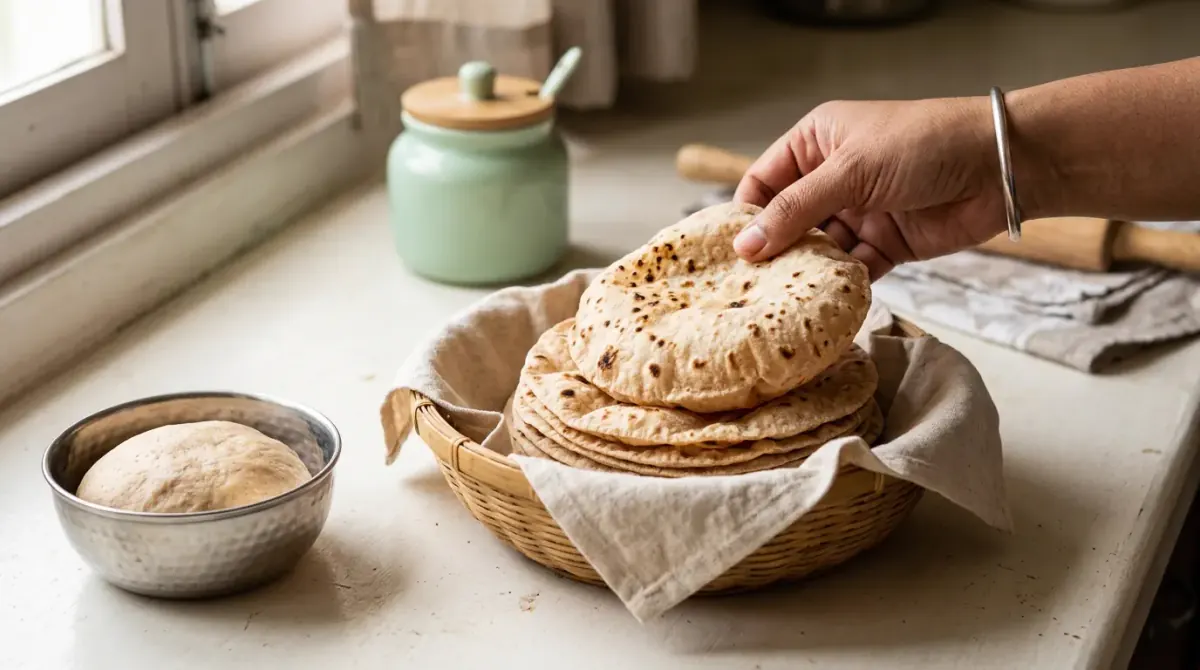
The calories in a roti come almost entirely from the atta, so the size of the dough ball decides everything. Whole wheat atta is about 340 to 360 kcal per 100 g. You can work out your own roti once and reuse it for good.
| Step | Calculation | Result |
|---|---|---|
| Atta used for the dough | 240 g at 360 kcal per 100 g | 864 kcal in the batch |
| Rotis made from it | 864 ÷ 8 rotis | 108 kcal per plain roti |
| Two rotis at lunch | 108 × 2 | 216 kcal |
| One teaspoon of ghee across both | Add 45 kcal | 261 kcal |
If your household makes 10 rotis from the same dough, each one is about 86 kcal. That gap, repeated over four rotis a day, is nearly 90 kcal, which is why a generic “1 roti” entry in an app can be wrong for you while being right on average.
What a katori holds
A standard steel katori holds about 150 ml when filled to just below the rim. Larger serving bowls hold 200 to 250 ml. Fill yours with water and pour it into a measuring jug once, and “one katori” becomes a real unit you can log.
Volume is not weight, though. A katori of thin dal and a katori of dry aloo sabzi hold the same volume and very different calories, so always say what was in it.
Oil and ghee decide the total
Boiled dal is about 100 to 120 kcal per 100 g and barely changes from home to home. What changes is the tadka. Two tablespoons of oil in a pot adds about 240 kcal to the whole batch; four tablespoons adds 480.
The dal is not the variable. The ladle of oil is.
To find your share, divide the pot. Suppose a pot of dal uses 150 g of dry lentils (about 510 kcal), one and a half tablespoons of oil (about 180 kcal) and onion, tomato and spices (about 40 kcal). That is roughly 730 kcal. Served into four katoris, each is about 180 kcal. Water adds volume and no calories, so a thinner dal means fewer calories per katori from the same pot.
Ghee added on the plate is separate. A teaspoon on rice or rotis is about 45 kcal each time, and it is the item people forget most.
Logging a full thali
Do not look for a “thali” entry. Break the plate into its parts and say them in order.
| Item | Portion | Estimate |
|---|---|---|
| Roti | 2 medium, plain | About 215 kcal |
| Ghee on the rotis | 1 teaspoon | About 45 kcal |
| Dal with tadka | 1 katori | About 150 kcal |
| Aloo gobi | 1 katori | About 150 kcal |
| Rice | Half a katori | About 100 kcal |
| Curd | 1 small katori | About 90 kcal |
| Total | About 750 kcal |
Said aloud, that is one sentence: “two rotis with a teaspoon of ghee, a katori of dal, a katori of aloo gobi, half a katori of rice and some curd.” Calur takes that sentence by text or voice, or a photo of the plate, and logs each part with its calories and macros. If you only finished half the rice, say so and the entry is corrected, not duplicated.
Chai, sugar and snacks
A 150 ml cup of chai made with half milk and one teaspoon of sugar is about 60 to 70 kcal. With two teaspoons of sugar and full-cream milk it is closer to 100. Three cups a day is 200 to 300 kcal, which is a small meal that never appears in most logs. The biscuits or rusk beside the cup count as well: two Marie-style biscuits are about 50 to 60 kcal.
Restaurant, mess and tiffin food
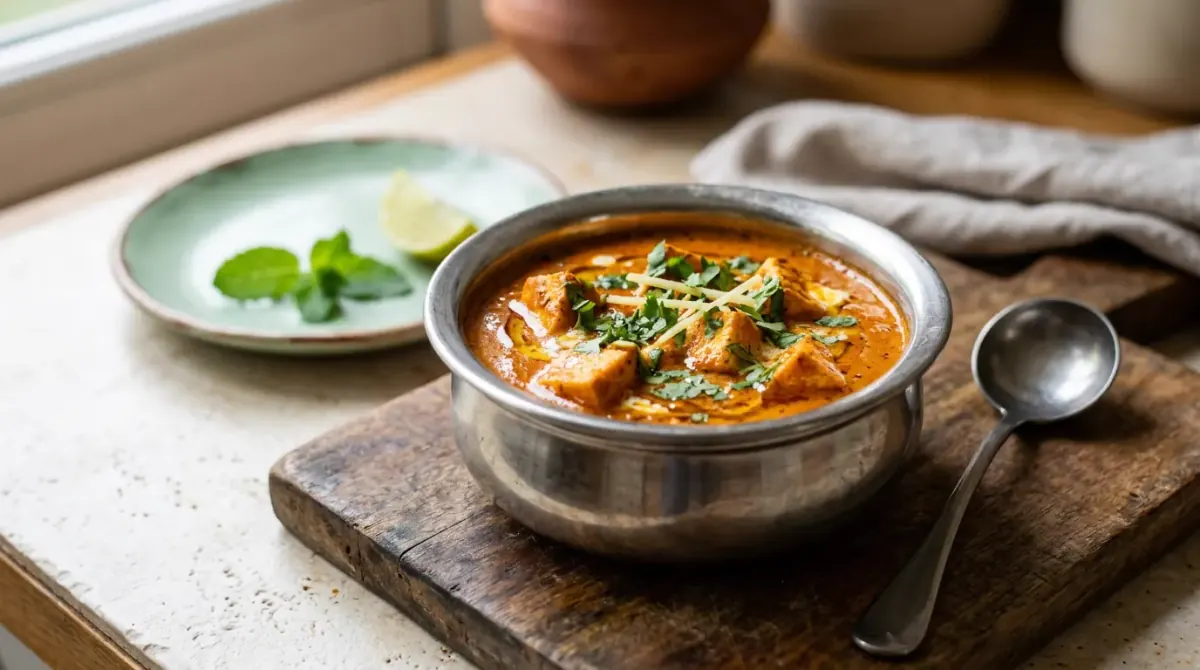
When someone else cooked, you do not know the oil, so assume more than you would use at home. Restaurant gravies such as butter chicken, paneer butter masala and dal makhani commonly run 350 to 500 kcal a serving before the naan. Describe the dish and the amount you ate, and accept a wider margin than you would for home food.
What to look for in a calorie counter for Indian food
- It understands household units such as katori, roti, ladle and teaspoon, without making you convert to grams.
- It lets you state the oil, ghee and sugar, and changes the numbers when you do.
- It can remember your own roti and your own katori so you set them once.
- It handles a mixed plate in one go, by photo or by description.
- It lets you correct a meal afterwards without creating a second entry.
Calur was built for this kind of logging. You can tell it once that your roti is 86 kcal or that your katori holds 200 ml, and it uses that from then on. It is free to start on Android and iOS, and Pro is ₹200 a month or ₹1,500 a year in India. For the general method behind hand and bowl portions, see how to count calories without a scale, and for how photo logging works see how AI calorie counters work. If you are choosing between apps, see Calur vs HealthifyMe, and use the macro calculator to set your protein, carb and fat targets.
Frequently asked questions
- How many calories are in one roti?
- A plain medium roti made from about 30 g of whole wheat atta is roughly 100 to 110 kcal. A small phulka is about 70 to 85 kcal. A teaspoon of ghee adds about 45 kcal.
- How many calories are in a katori of dal?
- A 150 ml katori of home-style dal with tadka is usually 120 to 180 kcal. Boiled lentils are fairly constant; the oil or ghee in the tempering accounts for most of the difference.
- How many calories are in a cup of chai?
- A 150 ml cup with half milk and one teaspoon of sugar is about 60 to 70 kcal. With full-cream milk and two teaspoons of sugar it is closer to 100 kcal.
- How do I count calories in home-cooked Indian food?
- Split the plate into its parts, such as rotis, dal, sabzi, rice and curd, and estimate each in household units. Add the oil, ghee and sugar you know about, and log only what you ate.
- Which calorie counter app works for Indian food?
- Look for one that accepts katoris, rotis and teaspoons, lets you state oil and ghee, and remembers your own portions. Calur logs Indian meals from a photo, a voice note or a typed sentence.
Published by the makers of Calur. About these guides and how they are prepared.